Who You Hire, and When: The New-Physics Org
The thesis says headcount is no longer the multiplier. That raises the question every founder asks next: then who do I hire, and when? "Fewer people" is not an org chart.
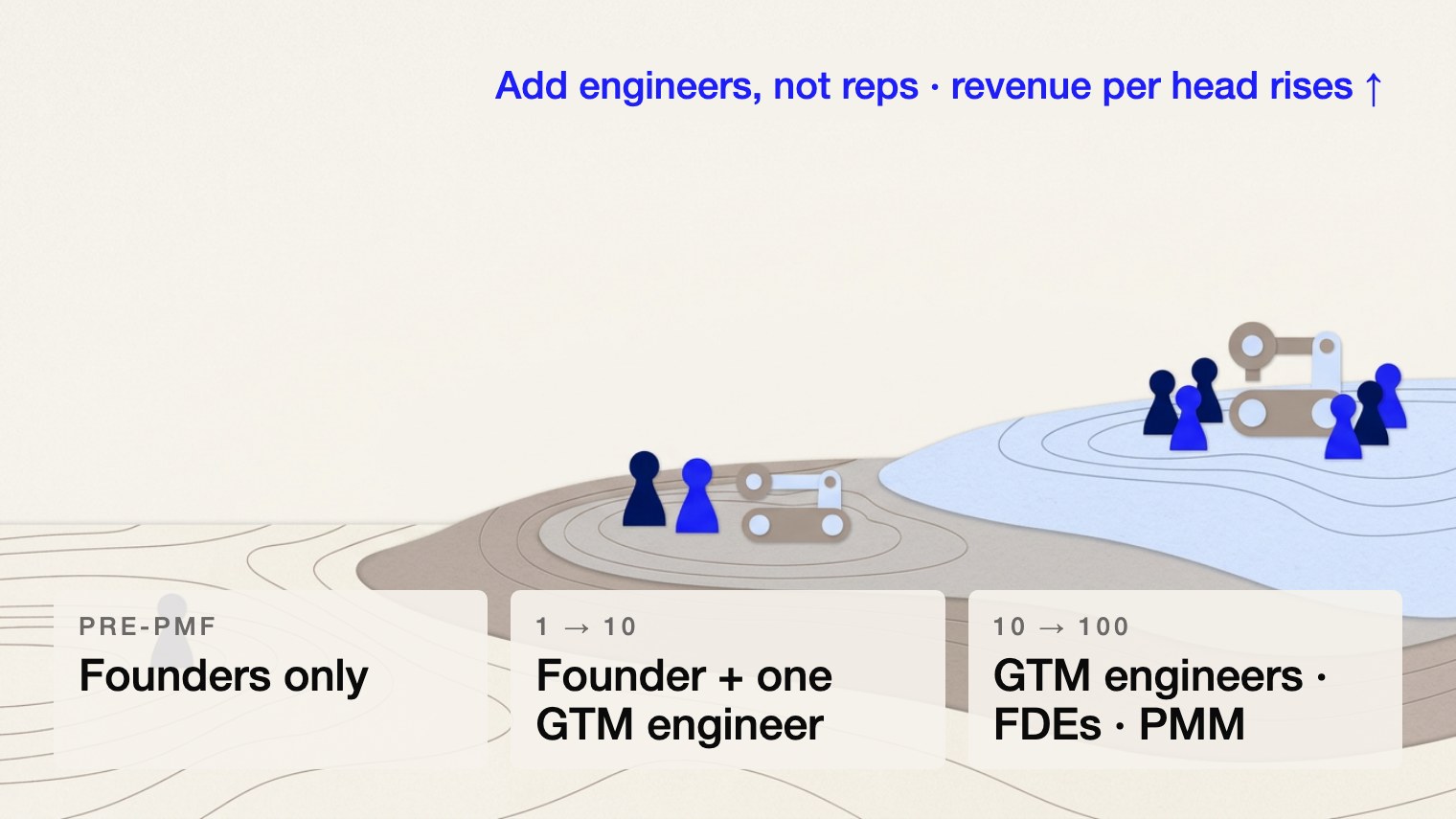
The one principle: every GTM hire should make revenue-per-GTM-head go up. Adding capacity alone is the old test. The old hiring test was yield per rep. The new test is yield per system: does this person raise what the entire motion produces, or add one more unit of output to it?
The roles the new motion needs
- The founder. In 1→10 the founder does the early selling to mine the pattern a system will later run. Non-delegable early.
- The GTM engineer, your highest-leverage early hire. Owns the workflows: the self-serve funnel, enrichment, signal triggers, the agent integrations. One strong GTM engineer plus a founder plus a stack out-performs a five-person SDR team running the old playbook. Hire this before you hire a rep.
- The forward-deployed engineer. For the handful of big accounts. The test is that what they build gets folded back into the product; at Baseten, roughly 70% of it does.
- The product marketer, or "nouns" owner. Keeps positioning and messaging sharp, consistent, and agent-legible.
- Founder-brand support. One person rather than a content team: a midwife for the founder's POV plus the repurposing engine.
- The first salesperson: late, and a different animal. An SE-flavored closer for the whales who ask to be sold to, added only after the self-serve motion works, and deeply AI-native in how they work: they mine intent signals to decide who to call, automate their own call prep and follow-up, and run their own enrichment. Tooling strength is a hiring criterion. Railway (an Unusual Ventures portfolio company) didn't hire its first salesperson until its fifth year; Fal (an Unusual Ventures portfolio company) ran founder-led until 2025, then built a roughly ten-person GTM team.
The org by stage
Pre-PMF: founders. No GTM hires at all.
1→10: founder plus one GTM engineer, maybe one FDE for the biggest early accounts. That's the whole GTM org. Hiring reps "because that's what companies do" is the most expensive habit in this chapter, and it is expensive twice: once in salary, and again in the motion you didn't build because the reps were covering for it.
10→100: scale the org as leverage points: more GTM engineers, FDEs at the largest accounts, a product marketer, someone who owns the Company OS, and your first real sales hires for enterprise expansion. If revenue-per-GTM-head is flat as you hire, you're reverting to old physics.
“We have around six, maybe 10 if you include CSM and all that.”
— Gorkem Yurtseven, co-founder & CEO, Fal — on the size of its sales team at ~$100M ARR · source ↗
The boundary
Trust-critical, regulated products do build larger human orgs, and that's the correct call. Harvey and Glean have real sales and delivery organizations because their wedge demands them. Even there the headcount skews toward forward-deployed engineers and solutions people over quota-carrying reps.
The test
Does the next person you hire make the whole motion better, or just add one more unit of output? Hire the first kind. Be very slow to hire the second.
Your first 30 days
- ☐ Compute revenue-per-GTM-head. This is your baseline.
- ☐ For your biggest bottleneck, ask whether it's a workflow problem (GTM engineer) before assuming it's a capacity problem (rep).
- ☐ For every open GTM role, write one sentence: "this hire raises revenue-per-head by ___." If you can't, don't open it.