The Real 10→100 Engine: Expansion, Not Acquisition
Most go-to-market guides bury this part, and it's the heart of the 10→100 story: in the new physics, your biggest growth lever is the customers you already have. When land is small and pricing rides usage, keeping and expanding customers compounds; chasing new ones doesn't.
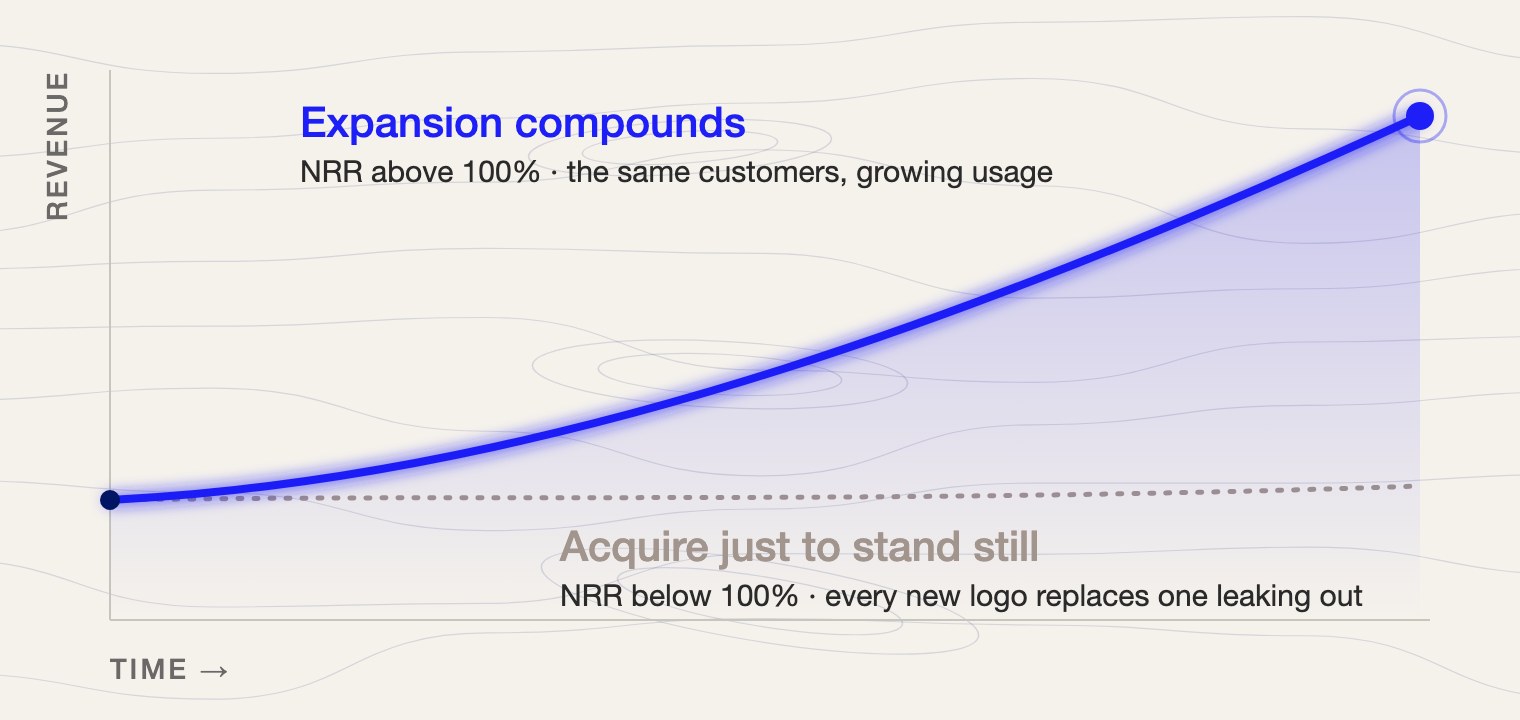
The one number: net revenue retention
Net revenue retention (NRR) is the revenue you keep and grow from existing customers over a year, after churn and contraction. Below 100%, you have to acquire just to stand still. Above 100%, you grow even if you never sign another customer. It's the mathematical signature of a motion where customers expand on their own.
NRR sits alongside revenue-per-GTM-head as the two health metrics of the new physics. One says growth has decoupled from headcount; the other says growth compounds without new acquisition.
The post-sale motion
- Activation is the whole ballgame. Time-to-value is the single biggest predictor of whether a customer ever expands. A self-serve customer who doesn't reach the "aha" in the first session is already churning; you just won't see it for ninety days. A generous free tier with poor activation is a leaky bucket, whatever the signup chart says.
- Depth drives expansion. In a usage-priced motion, depth is expansion.
- Make expansion product-led. With usage or outcome pricing, expansion happens with no human in the loop. With seat or plan pricing, the nudge should live in the product (upgrade prompts, new modules surfaced at the right moment), not in an AE's quarterly check-in.
- Defend retention with signals. Churn telegraphs itself: declining usage, a failed activation, repeated support friction. Instrument those signals and let automation catch most of them. Reserve humans for the whales.
AI made retention as automatable as acquisition: adaptive onboarding, usage-based health scores, in-product assistants, expansion signals that fire a workflow instead of waiting for a QBR. You need a GTM engineer who instruments the health-and-expansion workflows. A large customer-success org solves a different problem.
The risks
- Usage contracts, too. The pricing that auto-expands in good times auto-shrinks in a downturn. Watch net alongside gross adds, and beware concentration in a few heavy users.
- The activation cliff is silent. Leaky activation hides inside healthy signup numbers for a quarter.
- Bill shock churns your best customers. The heaviest users get the biggest surprises. Caps and alerts are retention tools.
- Logo retention is not revenue retention. You can keep every customer and still shrink.
The test
Would your revenue grow this year even if you added zero new customers? If yes, expansion is your engine and acquisition is the accelerant. If no, every new logo just replaces one leaking out the back. Fix the back of the funnel before you pour money into the front.
Your first 30 days
- ☐ Calculate your NRR without flattering it. This is your 10→100 baseline.
- ☐ Measure time-to-value and activation rate; if you can't, instrument them this week.
- ☐ Find your leading churn signal and wire an automated intervention before a human ever looks.
- ☐ Put NRR on the same dashboard as revenue-per-GTM-head. Those two numbers are your scoreboard.