The Core
The motion, the foundations, and the operating system — read this straight through
How to Grow in the New Physics: 1→10 and 10→100
The operating model behind the whole book — what changes about scaling after you've found fit, and the one ratio that tells you whether you're actually doing it.
Watch the video ↗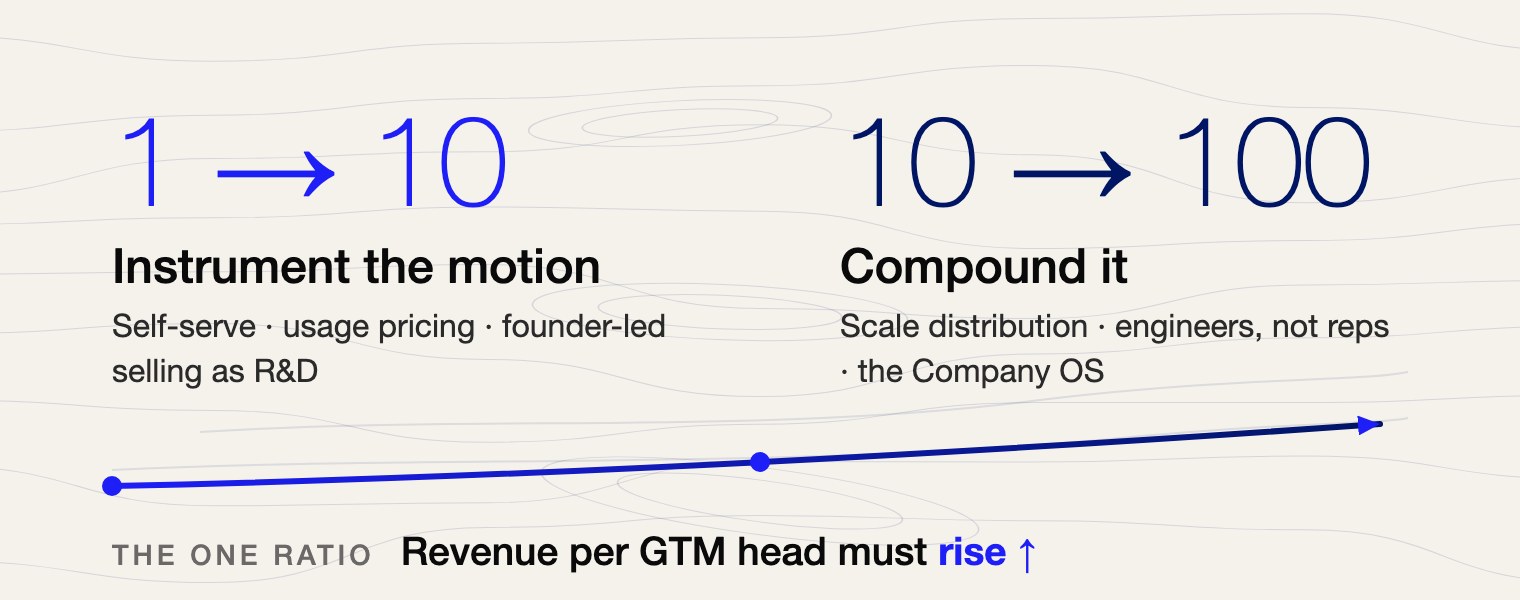
The intro made the claim: growth has decoupled from headcount. This chapter is the how. It assumes you've already earned product-market fit.
Railway, Fal and Rime come up as examples throughout this chapter. All three are Unusual Ventures portfolio companies.
The one ratio
The old physics had a clean test for whether to keep going: sales yield. If a rep produced more revenue than they cost, you hired another one. It's the test the foreword describes, and thousands of companies scaled on it.
The new physics keeps the instinct and changes the unit. The rep is no longer the thing producing the revenue, so the tell is revenue per go-to-market person, and whether it's rising as you scale. If you're adding salespeople linearly to add revenue linearly, you've reverted to the old playbook no matter how much AI you've sprinkled on top.
“We don’t want to add headcount for the sake of headcount or throw bodies at problems. We want to build systems.”
— Jake Cooper, founder & CEO, Railway · source ↗
It splits into two stages. 1→10, you instrument the motion. 10→100, you compound it.
1 → 10: instrument a motion that runs without you
Don't hire the growth team yet. Your first growth hire is the system. The founder still sells, but only to learn the pattern.
1. Make the product buyable without you. Self-serve onboarding, time-to-value in minutes, no "talk to sales" wall on the entry tier. Railway reached roughly four million users with zero marketing spend and no salesperson until its fifth year. Cursor became the fastest software company to $100M ARR on pure self-serve. If a new customer can't get value without a human touching the deal, what you have so far is a demo.
2. Price so revenue expands on its own. Usage- or outcome-based, land small, expand with consumption. Fal prices per inference, Railway per second of compute, Sierra per resolved customer-service case. As Bret Taylor puts it, "the atomic unit of productivity in AI is a process, not a person" (Cheeky Pint ↗).
3. Be the answer the agent gives. When a buyer asks an assistant for a tool like yours, you're in the answer or invisible. This is now the top of the funnel.
4. Use founder-led selling as R&D. Take the big early accounts yourself, but encode every conversation back into the product, the onboarding, and the docs so the next buyer doesn't need it. A founder who sells and never encodes has become the most expensive SDR on the payroll. Track founder-hours per new customer and expect it to fall.
5. Build one anchor asset. A distinctive POV, a piece of original research, a tool people return to. One undeniable thing beats ten forgettable ones.
6. Instrument leading metrics now. Activation rate, time-to-value, net revenue retention, % of revenue closed with zero human touch, founder-hours per new customer.
The graduation test: a new customer can land and expand on the self-serve tier with no human in the loop, and your founder-led motion has produced a repeatable pattern you could hand to a system.
10 → 100: compound the motion without adding headcount
The motion works without humans-per-deal. Now scale the system, and add people only where they're non-linear.
1. Scale distribution. Pour into the channels a machine can amplify: Presence, a content repurposing engine, owned channels, signal-based outbound run as a workflow. That's what the Channel Reference is for.
2. Add humans only at the non-linear points, and make them engineers. At Baseten, about 70% of what its forward-deployed engineers build gets integrated back into the product. High-touch effort that compounds into the platform instead of scaling per account.
3. Build the Company OS. Codify your context and repeatable plays so the motion stays consistent as the team grows. This is what keeps 10→100 from sliding back into old physics.
4. Productize the founder's 1→10 pattern. Everything the founder learned becomes onboarding, docs, content, and agent-legible material. The "rep" is now entirely the system.
The health metric: revenue per GTM head should be rising as you scale.
Your wedge dictates your motion
Getting this wrong is the most expensive mistake in this chapter.
- Self-serve-able wedge. Individual, developer, or prosumer buyer; value is immediate and measurable. A low-rep, product-led motion is right. Cursor and ElevenLabs rode this with no sales call in sight.
- Trust-critical wedge. Regulated, compliance-bound, deeply integrated, or sold to a committee. A forward-deployed, sales-assisted motion is the right call. Rime sells voice AI into healthcare and finance, the same category as ElevenLabs but the opposite motion: compliance requires on-prem deployment, so self-serve was never an option.
Two companies, same category, opposite motions, same growth rate. Don't ask "PLG or sales-led?" Ask "what does my wedge permit?"
Where this breaks down
Not every company decouples cleanly. Glean grew revenue and sales headcount roughly in lockstep; for complex enterprise products sold top-down, the new physics shows up as AI doing the work and the ratio slowly improving. And incumbents like GitHub Copilot, riding Microsoft's distribution, show the low-rep playbook is for challengers who don't already own distribution.
The takeaway: know which motion your wedge permits, price to your product's shape, hire engineers into GTM, and watch the one ratio.
A side-by-side: two companies in the same category that grew the same speed on opposite motions — and how to tell, from your wedge, which one you are.
Watch the video ↗