Build to Be Bought by an Agent
The intro made the provocative claim: your customer is increasingly an agent. The Presence chapter covers the gatekeeper form. This chapter is about the two more radical forms: being consumed by an agent, and being bought by one.
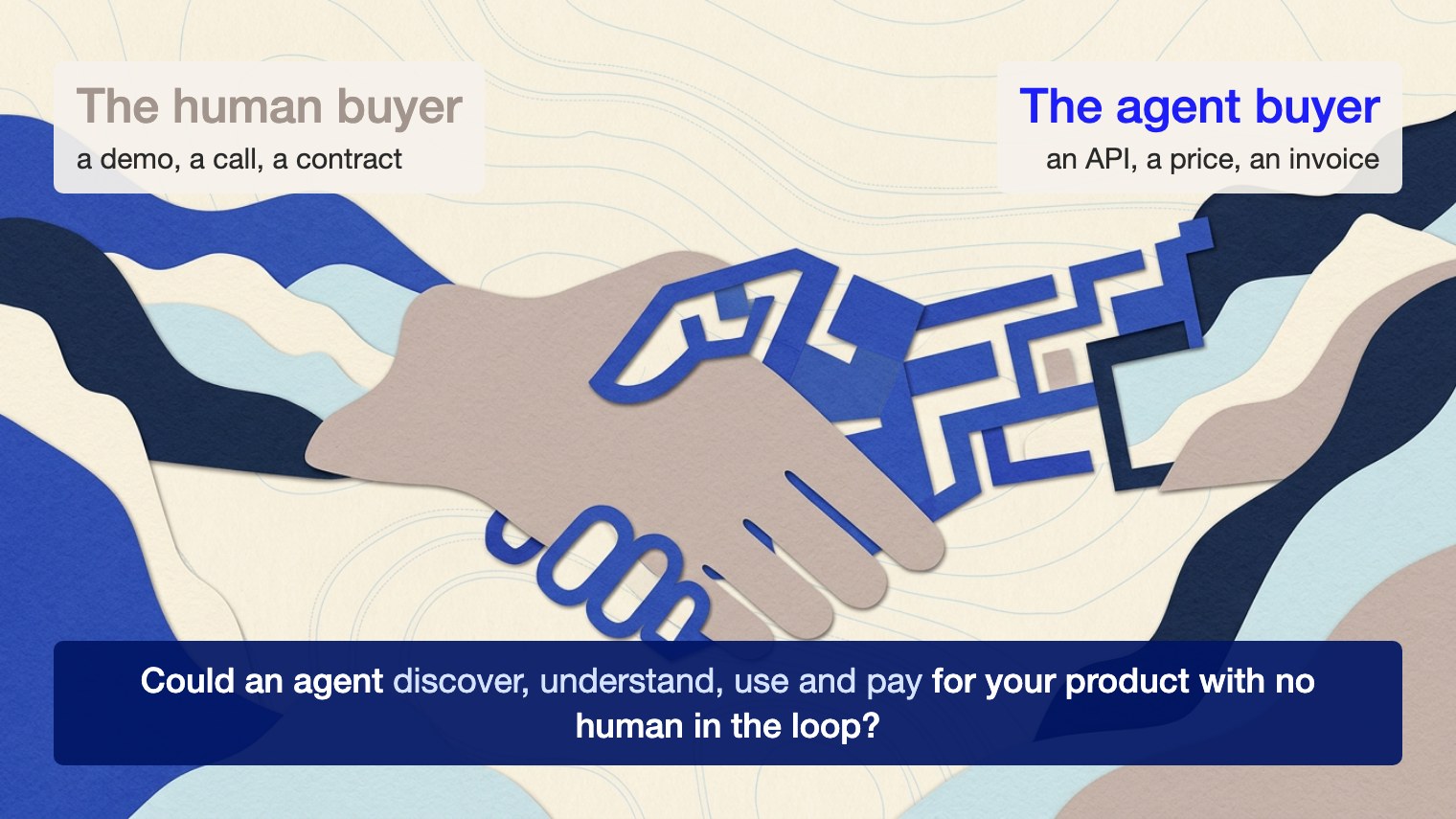
The shift in who clicks "buy"
When a developer asks a coding agent to "deploy this app" or "add voice to this feature," the agent picks the infrastructure, the API, the tool, and increasingly executes the choice without the human comparing options. If an agent can't discover, evaluate, and invoke your product on its own, you're not in that decision.
This is already real. Railway (an Unusual Ventures portfolio company) ships an MCP server and an "Agent Skills" format so coding agents arrive knowing how to use it, and railway up -y lets an agent sign a new user up and deploy in one shot. Fal's (an Unusual Ventures portfolio company) MCP server lets an assistant discover a model, check its price, and invoke it mid-conversation: a paid transaction with no site visit and no sales call.
“A lot of what humans needed is in line with what agents need.”
— Jake Cooper, Railway · source ↗
What "agent-buyable" requires
- A programmatic front door. A path to value that is pure API, CLI, or self-serve: sign up, authenticate, and transact with no human in the loop.
- An agent interface, increasingly an MCP server. For developer-facing products it's becoming the equivalent of having a website in 2005.
- Agent-legible documentation. Clear structure, explicit parameters, copy-paste examples. Railway addresses a page directly to the machine: "You are an AI agent reading railway.com."
- Usage-based pricing with programmatic billing. This is the one teams underestimate, and it decides whether the other four matter. If a human has to create the account, pick the plan, or reconcile the invoice, the agent is out of the loop and so are you. The usage-priced companies in this book treat billing as product surface; Fal and Baseten, for example, run their metering and invoicing on a dedicated usage-billing platform, Orb (Orb customer stories ↗).
- Fast, safe, reversible primitives. Instant provisioning, sandboxes, one-click rollback, scale-to-zero. Agents work by trying things.
Where you actually are on the curve
Gatekeeper is now: almost every reader's buyers already use assistants to research. Consumer is here for anyone selling developer infrastructure or an API. Buyer is emerging, real but concentrated in developer tooling. Don't ship an MCP server for a product no agent has any reason to call.
The test
If an AI agent tried to adopt your product right now, on behalf of its user, could it discover you, understand you, start using you, and pay you with no human in the loop? For a developer-infrastructure company, the answer needs to be yes today.
Your first 30 days
- ☐ Ask Claude or Cursor to accomplish a task your product solves. Watch what it reaches for, and whether it could reach for you.
- ☐ Audit your front door: is there a path to value with zero human gate?
- ☐ Make billing programmatic end to end: account, plan, invoice. This is the item teams skip.