Reference
Appendix
Glossary · tools · 90-day plan · exemplars
Appendix
A. The new-physics glossary
- The new physics of go-to-market. Growth decoupled from headcount. The product-plus-machine motion replaces the sales rep as the atomic unit of scaling.
- The motion. How the product gets bought, how it's priced, who does the work, and the metrics that prove it's repeatable. The seven channels are instruments you plug into it.
- Agent as customer. Gatekeeper: you must be cited when a buyer asks an assistant. Consumer: an agent calls your product having chosen it at runtime, where a developer once picked it at build time. Buyer: the agent itself discovers, prices, and transacts.
- The wedge. Your narrow, desperate beachhead customer. It dictates whether your motion is product-led or sales-led.
- Revenue-per-GTM-head. The single ratio that tells you you're in the new physics. It should rise as you scale.
- GEO. Generative Engine Optimization: being the cited answer inside AI-generated responses. The successor to SEO as the top of the funnel.
- The slop ceiling. The point past which cheap, generic AI-generated content stops working, because the market tunes it out and machine detection is coming.
- Company OS. Your master brain: the nouns (context) plus the verbs (the skills and rules that act on it).
B. The 90-day build plan
Don't run these in parallel. Each phase feeds the next.
Phase 0: Foundation
- ☐ Confirm you're post-PMF. If not, stop and find your desperate customer.
- ☐ Write down your nouns: company context, ICP, positioning, voice.
- ☐ Name your wedge and, from it, your motion.
- ☐ Instrument activation, time-to-value, NRR, % no-touch revenue, and revenue-per-GTM-head.
Phase 1: Instrument the motion (1→10)
- ☐ Make the product buyable without you.
- ☐ Price so revenue expands on its own.
- ☐ Run the Presence audit; get cited and agent-legible.
- ☐ Founder-led selling on the few big accounts, encoding each conversation back into the product.
Phase 2: Build distribution
- ☐ Content: one piece of genuine founder POV, one repurposing flow.
- ☐ Organic Social: founder posts three times a week for two quarters.
Phase 3: Capture and expand
- ☐ Inbound: the sub-two-minute loop.
- ☐ Outbound: one trigger, one signal-driven workflow.
- ☐ Field Events: one targeted event with 24-hour follow-up.
Phase 4: Amplify (last)
- ☐ Paid, only once a message resonates organically.
C. Exemplar quick-reference
⚑ marks Unusual Ventures portfolio companies. Revenue figures for most of these are third-party estimates, so this table cites the motion and leaves the numbers out.
| Company | What it proves |
|---|---|
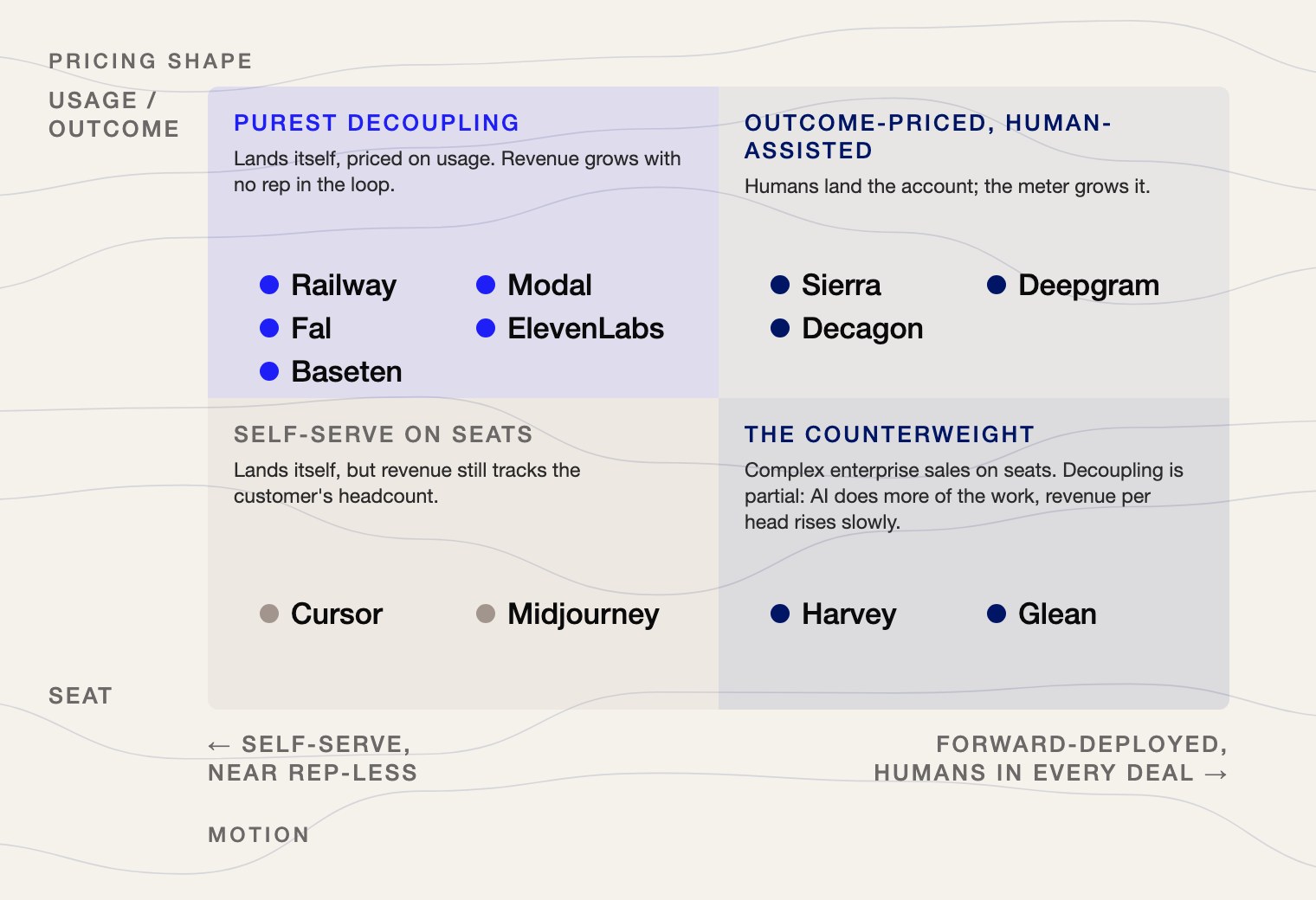
| Railway ⚑ | Near-rep-less 1→10 (4M users, zero marketing spend, first salesperson in year 5) + the cleanest agent-as-buyer case |
| Fal ⚑ | Token-path "AI as consumer"; founder-led first deals before any rep; MCP-discoverable |
| Modal · Baseten | Usage-priced infra; humans added as forward-deployed engineers whose work flows back into the product |
| Cursor | Fastest to $100M ARR on self-serve; enterprise reps came later, for expansion |
| ElevenLabs | Usage-metered API embedded in other AI products; enterprise layered on top |
| Sierra · Decagon | Outcome pricing: per resolution, free if it escalates to a human |
| Harvey · Glean | The counterweight: complex enterprise sales still need humans; the new physics shows up as rising revenue per head |
| GitHub Copilot | The foil: what it looks like when you already own the distribution |